Meet the DreamWave. It cools a nerve on your face — the one that flips your nervous system out of high alert — so a wired 2 AM brain can finally let go. The reason it works is stranger than you'd think.
QULLABY JOURNAL
Sponsored Content
SLEEP · PARENTING — MAY 2026
The 3-Minute Nerve Trick Doctors Use To Slow A Racing Heart — Now Built For Exhausted New Parents
It has nothing to do with melatonin, magnesium, or "sleeping when the baby sleeps." It works on the one nerve that flips your nervous system out of high alert — even when your body still feels like it's vibrating.
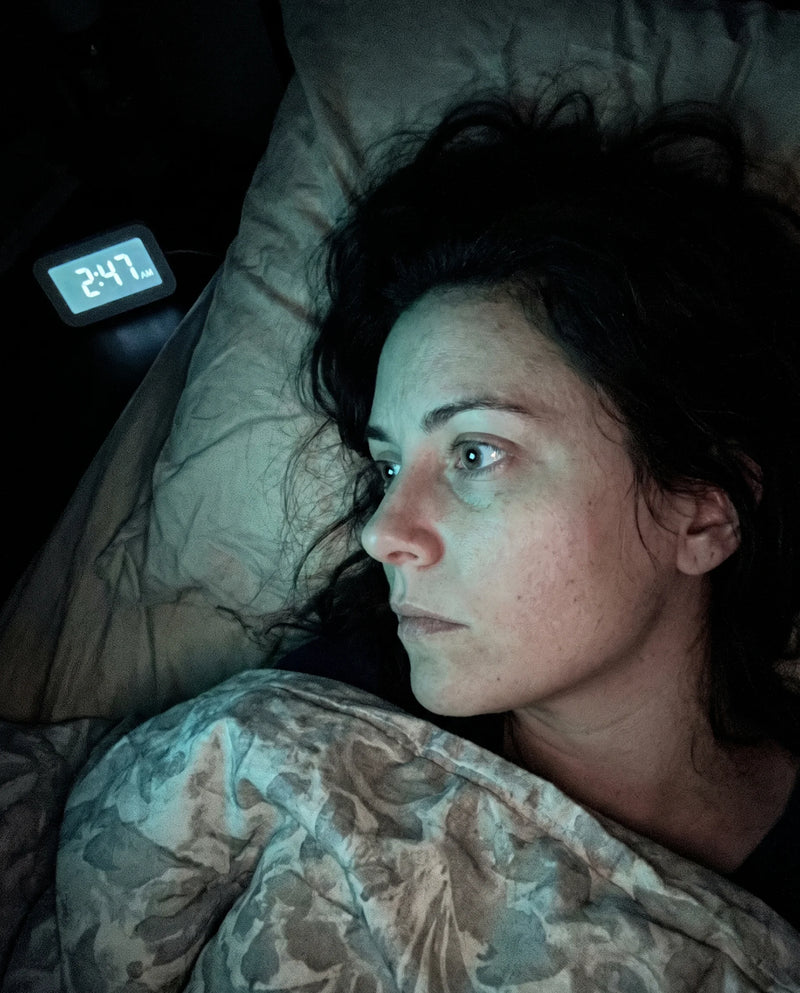
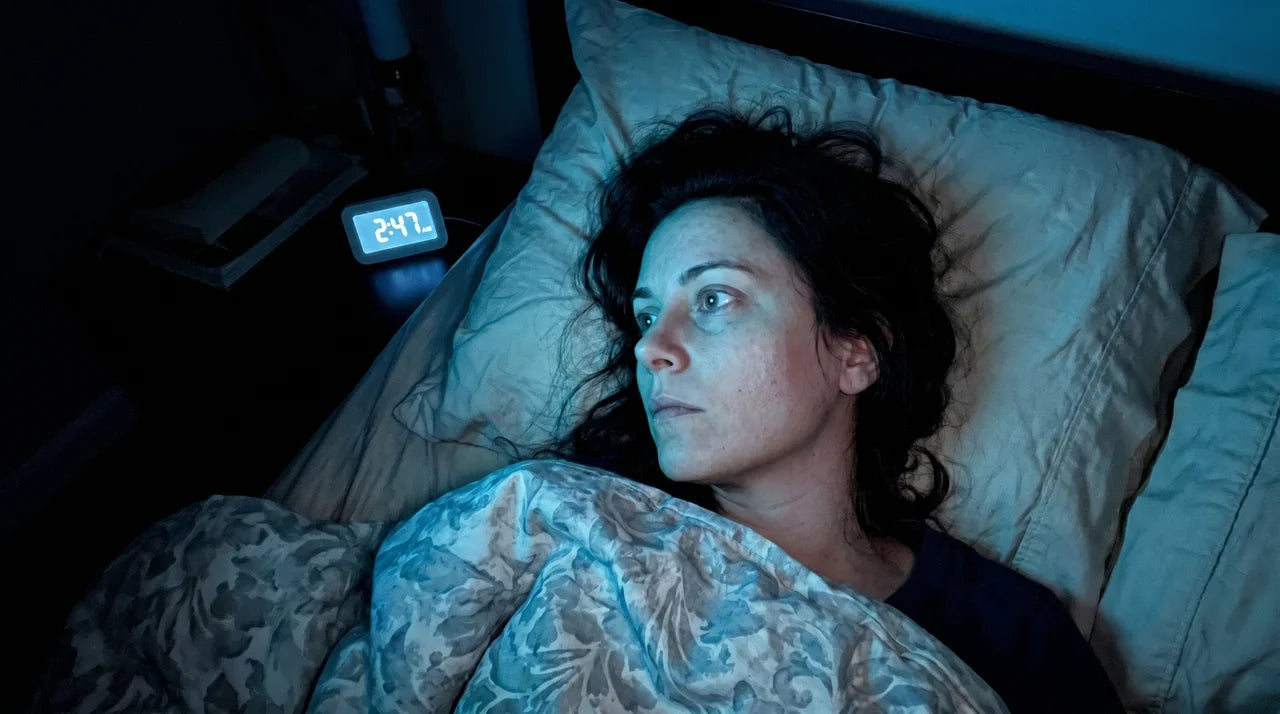
It's 2:47 AM. The baby is finally asleep, the house is finally quiet — the exact window you've been praying for all day — and instead of shutting down, your brain speeds up.
You're not broken, you're not a "bad sleeper," and you don't need another tub of magnesium or another relative telling you to "sleep when the baby sleeps." What's happening to you isn't insomnia. It has a name — and the name changes what fixes it.
Sleep researchers call it hyperarousal: a measurable state where your nervous system stays switched on — heart rate up, cortisol circulating, body in low-grade vigilance — even when you're exhausted enough to cry. Your body wants to sleep. Your nervous system won't let it. That's not a flaw. Every mammal that raises an infant rewires for this vigilance so a baby's cry can reach them. Evolution wanted it. It's also why, months in, you still can't sleep when the baby finally does.
You don't have a sleep problem. You have a nervous system problem.
And you're not an outlier: 67.8% of new mothers report poor sleep in the first six months postpartum, and 41% still report insomnia symptoms two years out (Okun & Lac, 2023, Biopsychosocial Science and Medicine).
67.8%
OF NEW MOTHERS REPORT POOR SLEEP QUALITY IN THE FIRST 6 MONTHS POSTPARTUM
Okun & Lac, 2023, Biopsychosocial Science and Medicine
But here's what almost no one tells you: there's a single nerve on your face that flips that switch off — and someone finally built a way to trigger it from bed.
What You've Probably Already Tried
You've tried things — of course you have. Probably at least three of these:
1
Melatonin.
Pulls you into a deep, groggy, slow-to-wake state — the opposite of what you need at 1 AM when the baby cries and you have to stand up and navigate a dark hallway. Plenty of parents call it "actively dangerous" near a sleeping infant.
2
Calm, Headspace, Insight Timer.
Good apps. But to start a track at 2 AM you stare into a bright screen — blue light, exactly wrong for sleep — and the meditation runs 20–30 minutes. Your nap window is 45.
3
Foam earplugs.
Block the one sound you can't afford to miss: your baby. Most moms try them once, lie awake terrified, and never wear them again.
4
A regular silk sleep mask.
Blocks light, does nothing for your nervous system. You're still wired — just in the dark.
5
A Bluetooth sleep mask from Amazon.
The speakers are 8mm of hard plastic. Sleep on your side (and you do — you can't pump on your back) and they press into your ear cartilage all night. Reviews are full of being jolted awake at 3 AM by the thing announcing "BATTERY LOW" at full volume into your ear.
You're not failing. The tools are failing. They were built for general consumers — not for someone whose entire physiology has been rewired by parenthood.
So if it isn't a discipline problem, and it isn't a melatonin deficit — what is it, and what fixes it?
The Answer Hiding On Your Face
Your face has a cranial nerve called the trigeminal nerve. Its top branch — the ophthalmic branch, V1 — covers your forehead, upper eyelids, and the area around your eyes. And it has a strange, useful property.
When V1 is exposed to cold, it triggers an immediate shift from sympathetic activation (fight-or-flight) to parasympathetic activation (rest-and-digest). Heart rate slows. The system holding you in 2 AM vigilance turns down.
This isn't pseudoscience. The mechanism is the trigeminocardiac reflex — its more famous cousin is the mammalian diving reflex, the same reflex that lets free-divers drop their heart rate at depth, the same one emergency physicians trigger to break a dangerous fast heart rhythm, and the same one DBT therapists use in the TIPP protocol to talk people down from acute panic. (Sources: NCBI StatPearls; American Physiological Society; clinical literature on cold-water immersion and cardiac response.)
What's not documented is anyone using it to fall asleep. Until now, the only ways to trigger it were a bowl of ice water (try that at 2 AM) or an ice pack that melts and wakes you up wet at 3 AM. None of them work for someone trying to drift off.
That's the gap nobody had built for.
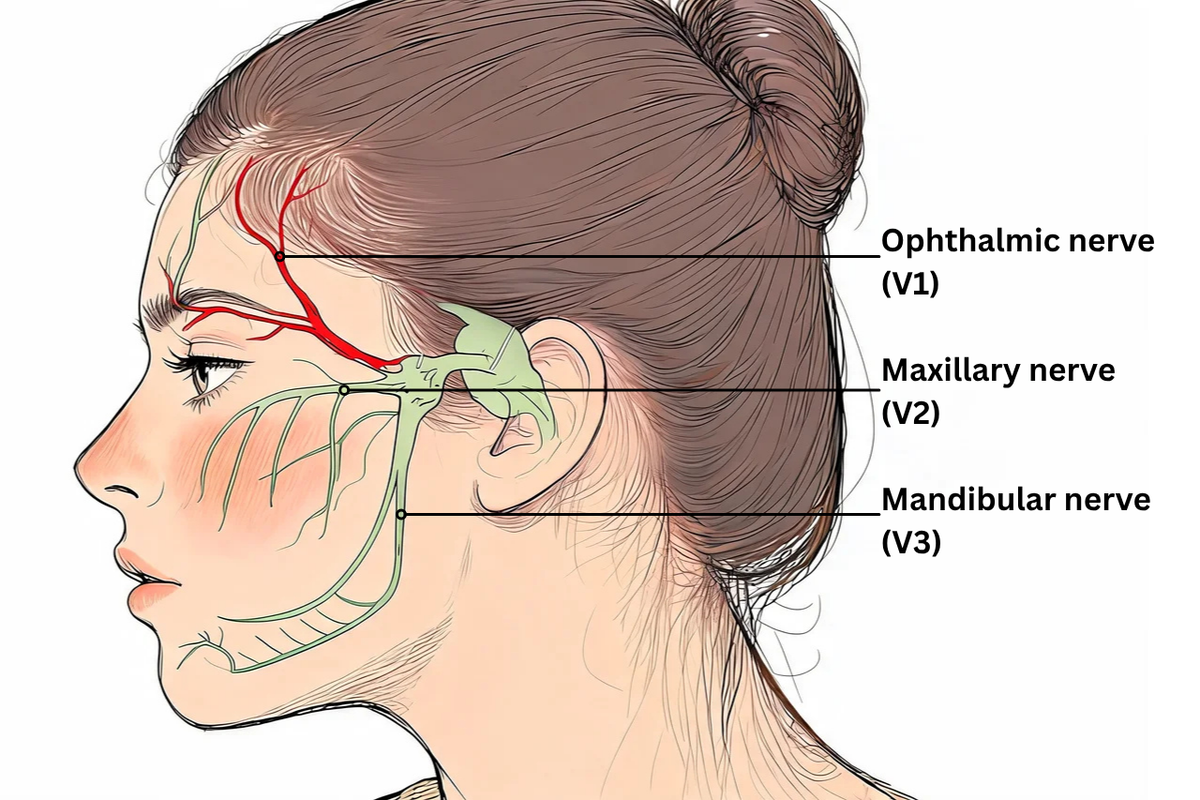
The V1 ophthalmic branch — the nerve the DreamWave's cooling inserts sit directly over.
What Happens When You Combine Cooling And Total Blackout
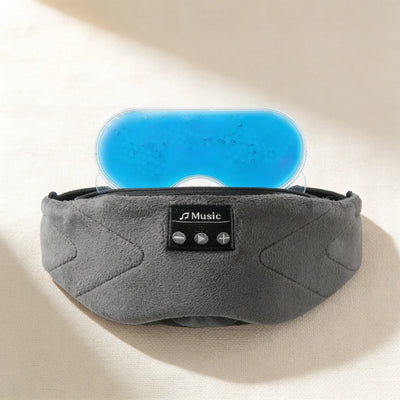
The Qullaby DreamWave is a sleep mask built around that reflex. The reason it works isn't any single feature — it's the combination.
Trigeminal cooling.
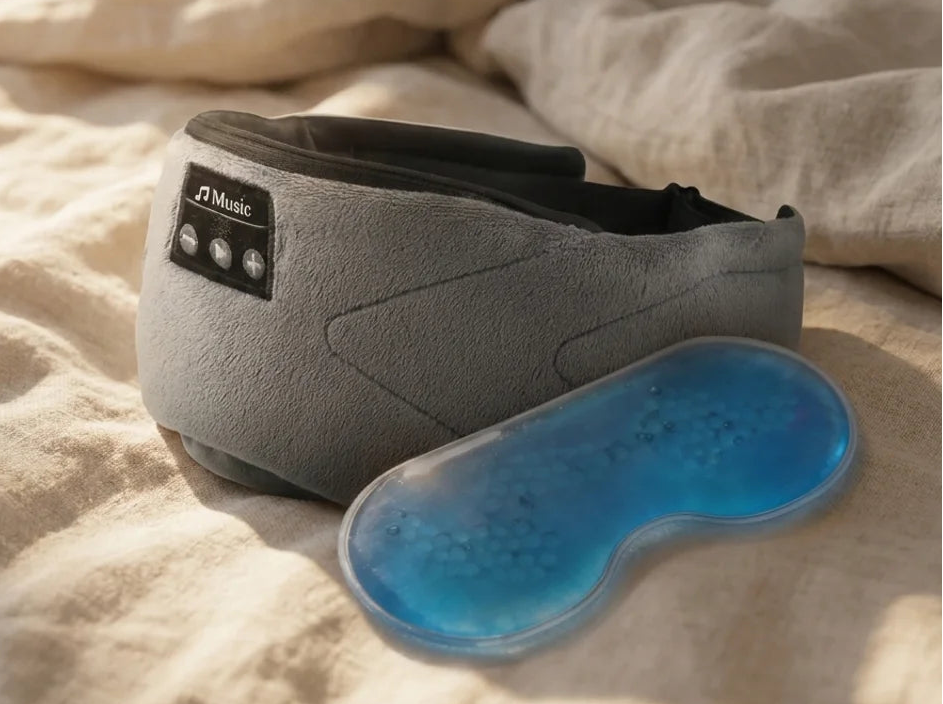
Removable gel inserts sit directly over the V1 zone: forehead, upper eyelids, around the eyes. Out of the fridge they stay cool for ~20–30 minutes — the length of a real postpartum nap window — then rinse and re-chill between uses. This is the part that shifts your nervous system out of hyperarousal.
Total blackout.
Contoured seals wrap the face with no light leakage, even on your back, your side, or face-down. Built specifically for the side-sleeping parent — the breastfeeding parent, the pumping parent, the partner-of-the-snorer parent. Most of you reading this.
Built-in sound, on demand.
A slim Bluetooth speaker (4mm drivers — half the thickness of the hard-plastic Amazon headbands, so you can sleep on your side and not feel them) with 24 sleep tracks pre-loaded — no app, no phone, no screen. It's there for when you want to wall off the chaos of the outside world: a partner up late, traffic, a houseful of in-laws over the holidays. Tap once and a curtain of sound drops around you. Most nights you'll run cooling and blackout alone and leave it off — but on the nights you want it, it's there.
Hyperarousal isn't one problem — it's a nervous system that won't downshift and a brain with nothing to do but spin. Cooling handles the downshift. Blackout removes the visual trigger. And when you need to shut out the world, the sound is one tap away. A single ice pack, a single sound machine, a single mask each solve one piece. This solves the stack.
Specs: Bluetooth 5.2 · USB-C charging · ~35 hours of audio per charge · machine-washable cover, removable electronics · gel insert included · travel pouch included
Everything In Your Order
- Qullaby DreamWave Sleep Mask
- 24 Pre-Loaded Sleep Tracks
- Cooling Gel Insert
- Travel Pouch
- Free Shipping
- 30-Night Sleep Guarantee
Single Mask
99.99
$79.99
20% off
Color:
Best Value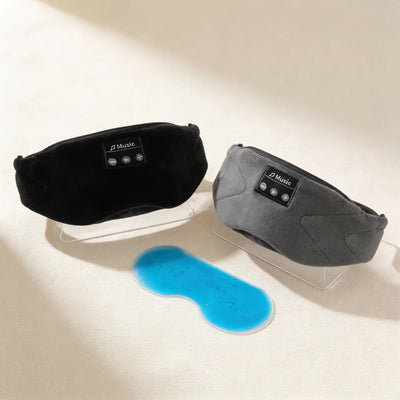
Couple's Bundle
$199.98
$129.99
35% off
Your mask:
Partner's mask:
Today:$79.99
Please select a color to continue.
- Free Shipping
- 30-night sleep guarantee — full refund if it doesn't work
- Ships within 2 business days
- Secure Checkout
| Feature | Qullaby DreamWave | Manta Sleep | Musicozy / LC-Dolida | Silk Mask |
|---|---|---|---|---|
| Trigeminal cooling | ✓ | ✗ | ✗ | ✗ |
| Side-sleeper speaker (≤4mm) | ✓ | Bulky foam cup | 8mm hard plastic | n/a |
| Total blackout | ✓ | ✓ | Partial | Partial |
| Silent shutoff (no voice alerts) | ✓ | n/a | ✗ | n/a |
| Pre-loaded sounds (no app) | ✓ (24 tracks) | ✓ | ✓ | ✗ |
| 30-night money-back guarantee | ✓ | Limited | Limited | Varies |
| Price | $99.99 | $149+ | $25–40 | $15–30 |
"But Will I Hear My Baby?"
This is the first thing every mother asks. Here's the honest answer.
At night, with a baby in the next room, you run the DreamWave the way it's meant to be run: cooling on, blackout on, sound off. And with the speaker off, the mask does nothing to your hearing. It sits over your eyes — your ears stay open. You hear your baby exactly as you would with nothing on your head at all.
The built-in sound is something you switch on by choice — for a daytime nap, the contact-nap window in the rocking chair, or a night you want to shut out the world. It is never something running against you while your baby sleeps. If you want extra reassurance for the first couple of weeks, keep a monitor on the nightstand; the mask doesn't block a monitor speaker an arm's length away. Most parents stop bothering once they've confirmed it for themselves.
You're going to hear your baby. The mask covers your eyes, not your ears.

Why Your Partner Should Be Wearing One Too
The conversation about postpartum sleep usually skips fathers. It shouldn't.
A meta-analysis in JAMA found that 25.6% of fathers experience clinical depressive symptoms in the three to six months after a baby is born — climbing toward 50% when the mother also has postpartum depression — and about 18% meet clinical thresholds for anxiety. (Sources: Paulson & Bazemore, JAMA 2010; Cleveland Clinic.)
He's losing sleep too. Richter et al. (Sleep, Oxford University Press, 2019) put new mothers' loss at 87 minutes a night in the first three months and new fathers' at 27 minutes — and his version happens in a culture that won't acknowledge it. He's expected to be at work at 8 AM, alert, the morning after the same broken night you had.
A second DreamWave isn't a luxury. It addresses a real physiological cost nobody else is going to acknowledge for him. This is a household tool, not a gendered one.
Everything In Your Order
- Qullaby DreamWave Sleep Mask
- 24 Pre-Loaded Sleep Tracks
- Cooling Gel Insert
- Travel Pouch
- Free Shipping
- 30-Night Sleep Guarantee
Single Mask
99.99
$79.99
20% off
Color:
Best Value
Couple's Bundle
$199.98
$129.99
35% off
Your mask:
Partner's mask:
Today:$79.99
Please select a color to continue.
- Free Shipping
- 30-night sleep guarantee — full refund if it doesn't work
- Ships within 2 business days
- Secure Checkout
April 9, 2025
A Tuesday Night In April
There's a version of this story that starts with a sleep researcher in a lab, and another that starts with a wellness brand sniffing out a market. Neither is what happened.
What happened is that on a Tuesday night in April, a mother of a four-month-old sat on the edge of her bed at 4:17 AM, holding a frozen bag of peas against her face, sobbing. The four-month regression had hit two weeks earlier; her baby was waking every 70 minutes. She'd tried melatonin and woke up too groggy to walk the hallway safely. She'd ordered a Musicozy mask off Amazon — the speakers had bruised her right ear so badly she couldn't sleep on that side.
That night she remembered something from a college physiology class — the diving reflex, something about cold and the nervous system — and dug the peas out of the freezer in desperation.
Twelve minutes later, against every expectation, she fell asleep.
Forty-six minutes later the baby woke. She fed him, put him down, came back, pressed the now-melting bag to her face again — and twenty minutes later she was asleep again. It was the first time in nineteen weeks she'd fallen asleep twice in one night.
The next morning she started reading: the trigeminocardiac reflex, the diving-reflex research, a thread of free-divers describing exactly what she'd felt, the DBT TIPP protocol where cold-on-the-face is the first letter. Emergency physicians had known about this for decades. Nobody had built it for parents.
The cooling inserts came first. Then the eye-cup geometry that wouldn't crush a side-sleeper's lashes. Then the 4mm drivers that wouldn't bruise an ear. Then a long stretch of getting the details right. Then this page.
The thing on your phone at 2:14 AM is the result.
The truth is, this is not a magic product. It will not solve sleep deprivation, make your baby sleep through the night, or restore the version of you that existed before all this. What it does is one specific thing well: it shortens the gap between I am exhausted and I am asleep. For a parent whose window is 45 minutes, that gap is the difference between a real nap and another half-hour staring at the ceiling.
This is for you if:
- You're in the first year postpartum and your sleep is fragmented
- You're breastfeeding, pumping, or doing primary night-feeds
- You're parenting through the 4-month or 8-month regression
- You're back at work and "function on 4 broken hours" isn't adding up
- You've already tried melatonin, Calm, earplugs, and a regular mask — and watched all four fail in the same week
This is not for you if:
- You have diagnosed sleep apnea and need a CPAP — use that first; you can add this on top
- Your baby is under one month old — survive first, equip later
- You're looking for "8 hours of continuous sleep." We won't promise that. What this gives you is the ability to fall asleep faster in the windows you already have
We'd rather lose the sale than have you buy this and feel oversold to.
The 30-Night Sleep Guarantee
Use the DreamWave for 30 nights. If your sleep hasn't measurably improved — if you're still lying there at 2 AM with the same brain you had before — send it back. Full refund, no quiz.
The 30-night frame is deliberate. The cooling effect is immediate; most people feel it the first night. The falling-asleep-faster effect builds as your nervous system learns to pair the cooling with sleep — and thirty nights is the window in which that pairing locks in. If it doesn't work for you, we'd rather refund you than have an unused mask in a drawer.
Everything In Your Order
- Qullaby DreamWave Sleep Mask
- 24 Pre-Loaded Sleep Tracks
- Cooling Gel Insert
- Travel Pouch
- Free Shipping
- 30-Night Sleep Guarantee
Single Mask
99.99
$79.99
20% off
Color:
Best Value
Couple's Bundle
$199.98
$129.99
35% off
Your mask:
Partner's mask:
Today:$79.99
Please select a color to continue.
- Free Shipping
- 30-night sleep guarantee — full refund if it doesn't work
- Ships within 2 business days
- Secure Checkout